
Most Canadian retailers set free-shipping minimums between $25 and $100, with $35 and $50 the most common figures for general merchandise. Heavier or specialty items, including auto parts, often carry higher thresholds or flat-rate shipping instead. Eligibility rules typically exclude remote postal codes, oversized products, and sometimes third-party marketplace sellers. Thresholds are usually calculated after discounts but before tax, so confirm the exact wording on the retailer's shipping or FAQ page before checkout.
TL;DR:
- Most Canadian retailers set free-shipping thresholds between $25 and $100, with general merchandise typically requiring $35 to $50 to qualify.
- Heavy or specialty items like auto parts often require a higher minimum, such as $85 to $150, due to their weight and shipping complexity.
- The threshold is usually based on the cart subtotal after discounts and before tax, with exclusions like gift cards, warranties, or oversized products common.
- Confirm your eligibility by checking retailer policies, testing the checkout process, and considering remote location surcharges for rural postal codes.
- Auto parts retailers like DBC Brakes set their free-shipping minimum at $100, explicitly covering heavy-item deliveries without hidden fees.
Table of Contents
- What is the typical free shipping threshold in Canada by retailer type?
- How do retailers calculate the free shipping threshold?
- How can you confirm a retailer's shipping rules before checkout?
- What are the best ways to avoid shipping fees in Canada?
- Do free shipping thresholds change by province?
- How does the free shipping threshold change what Canadians buy?
- How do online retailers set their free shipping threshold with carriers?
- What actually matters when you're checking a free shipping rule
- DBC Brakes' free shipping threshold for Canadian orders
- Where to verify these free shipping rules yourself
- Sources
- FAQ
What is the typical free shipping threshold in Canada by retailer type?
Free-shipping minimums are not one-size-fits-all in Canada. They shift depending on what kind of retailer you're buying from and how much margin that retailer has to absorb delivery costs.
Big marketplaces and general retailers tend to sit at the lower end. Amazon Canada, for example, offers free shipping on eligible orders of $35 or more for existing customers, excluding some sellers and remote locations. Office and home retailers follow a similar pattern. Staples Canada sets its free-shipping line at $35 too, charging roughly $5.99 on orders that fall short.
Clothing and mid-market fashion chains often set the bar a little higher, and membership status changes the math. Some fashion retailers advertise free shipping thresholds around $35 to $50 for reward members, with a different, often higher, threshold or flat fee for non-members.
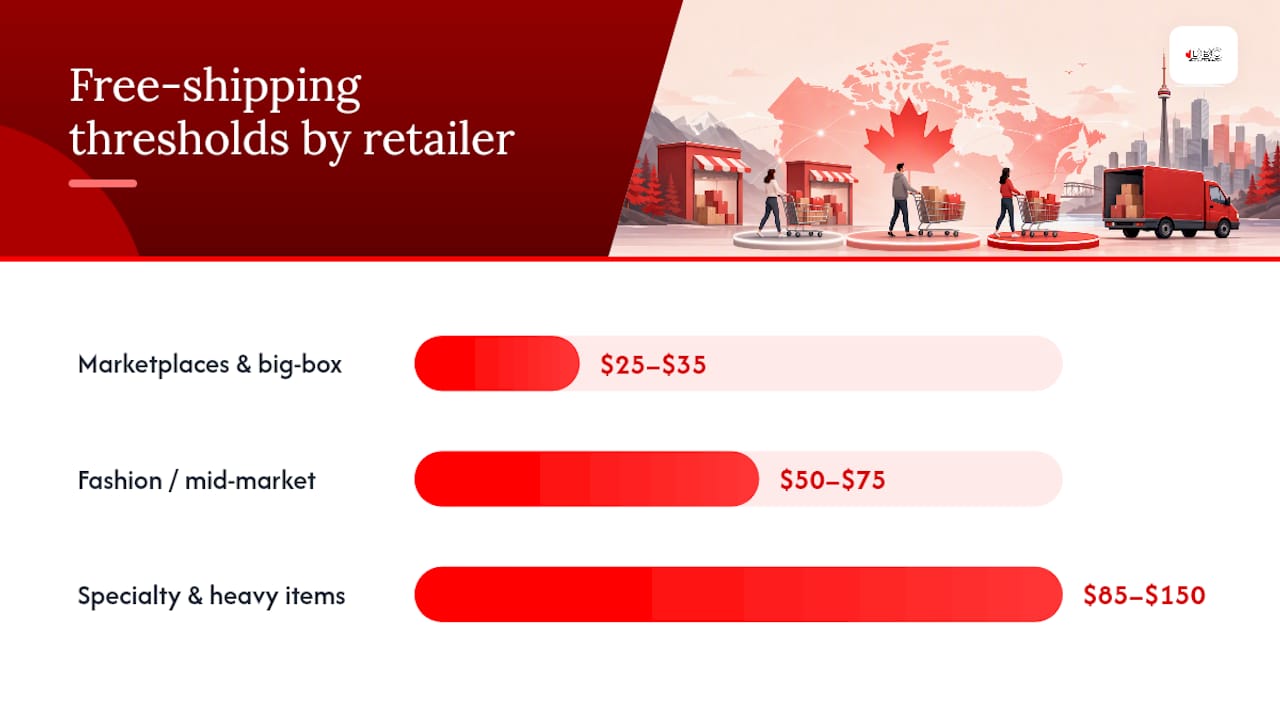
Specialty retailers and sellers of heavy goods sit at the top of the range. Auto parts, appliances, and furniture often come with separate shipping logic altogether, since the cost of moving a 20 kilogram rotor across the country doesn't compare to shipping a T-shirt.
Here's a rough map of what shoppers commonly see:
- $25 to $35: marketplaces and general big-box retailers, often for existing account holders
- $50 to $75: fashion and mid-market retailers, sometimes locked behind loyalty membership
- $85 to $150 or flat-rate: specialty and heavy-item retailers, including auto parts sellers, where weight and packaging drive the cost
Knowing which bracket your purchase falls into saves you from assuming a $35 rule applies everywhere. It usually doesn't.
How do retailers calculate the free shipping threshold?
The dollar figure on a shipping page rarely tells the whole story. Retailers apply that number to a specific version of your cart total, and the details vary enough that guessing gets shoppers into trouble.
- Subtotal timing matters. Most retailers calculate the threshold on your subtotal after any promo codes or discounts are applied, but before sales tax. Staples Canada's shipping page confirms this order of operations, and it's worth checking, since a retailer that counts pre-tax versus post-tax totals can change whether you qualify by a few dollars.
- Some items don't count at all. Gift cards, extended warranties, and oversized or overweight products frequently get excluded from the threshold calculation, even when they're sitting in the same cart as eligible goods. Marketplace items sold by third-party sellers can also fall outside the retailer's own free-shipping rule.
- Remote and rural postal codes get treated differently. Canada's geography means shipping costs balloon once a package leaves major population corridors. Retailers typically flag remote-location exclusions directly in their shipping policy rather than surprising you at checkout, though the fee still shows up there if it applies.
- Membership status can override the standard rule. Loyalty or paid membership tiers sometimes remove the threshold entirely, offering free shipping on every order regardless of cart size, or they lower the bar from $50 to $35 for members only.
None of these rules are universal. The only way to know for certain is to read the specific retailer's policy, which is tedious, but cheaper than an unexpected $15 shipping charge.
How can you confirm a retailer's shipping rules before checkout?
You don't need to guess, and you shouldn't have to. A four-step check takes less than two minutes and prevents the classic "why did shipping cost more than I expected" moment at the final screen.
- Find the shipping or FAQ page. Most retailers link it in the footer. Search the page for "free shipping" or "delivery" and read the exact dollar threshold and any exclusions listed.
- Check the product page and cart for live messaging. Many sites display eligibility notices directly on the product listing or inside the cart, often phrased as "eligible items" or "qualifies for free shipping."
- Run the checkout funnel to the shipping step. This is where remote-location surcharges and weight-based fees actually surface. Amazon Canada's shipping eligibility notices appear on both the product page and again at checkout, and testing the funnel is the fastest way to see if your postal code triggers an extra charge.
- Contact support for edge cases. Heavy items like brake rotors or wheel bearings sometimes need a direct question to customer service to confirm the real shipping cost.
Pro Tip: Add your item to the cart and change the shipping address to your actual postal code before you commit to buying. Remote-location surcharges often stay hidden until that exact step.
What are the best ways to avoid shipping fees in Canada?
Meeting a free-shipping threshold is often a matter of small adjustments rather than spending more than you planned to.
- Top up with items you'd buy anyway. Add a small, low-cost item that counts toward the subtotal, such as a consumable or accessory, rather than padding your cart with something that might be excluded from the calculation.
- Do the membership math before signing up. A loyalty membership fee is worth it only if you order from that retailer several times a year. Compare the annual fee against your typical shipping spend before committing.
- Use pickup options when they exist. In-store pickup, curbside, or click-and-collect sidestep the shipping question entirely, and many retailers waive delivery charges completely for these options.
- Combine orders where possible. Timing a purchase to coincide with a household member's order, or waiting for a promotional free-shipping window, often closes the gap without spending extra money.
- Compare shipping rules for heavy items specifically. Auto parts retailers handle weight-based shipping very differently from general merchandise sellers. Some absorb shipping once your cart clears a set value; others charge a flat heavy-item fee regardless of cart size. Comparing retailers before buying brake components can be the difference between free delivery and a $50 surcharge.
Do free shipping thresholds change by province?
The dollar figure on a shipping policy rarely changes by province, but what you actually pay to hit it often does. A $35 threshold reads the same in Toronto and in Whitehorse, but the shipping cost avoided by clearing that threshold is far higher outside major corridors.
Ontario, Quebec, British Columbia, and Alberta sit closest to national distribution hubs, so retailers can offer flat free-shipping thresholds with the fewest exceptions. Atlantic Canada, Northern Ontario, and the Prairies see more frequent surcharges for remote postal codes, even when the advertised threshold is identical.
The territories face the steepest gap. Nunavut, the Northwest Territories, and Yukon are commonly excluded from standard free-shipping programs altogether, or routed through a separate remote-shipping calculation that can add significant cost regardless of cart size. This is one reason retailer policies consistently flag remote and rural exclusions rather than promising a blanket rule.
For Canadian shoppers outside major cities, the practical takeaway is this: the advertised threshold is the starting point, not the final answer. A $50 free-shipping minimum in a national ad campaign might still carry a rural surcharge once your specific postal code is entered at checkout. Running the checkout funnel with your actual address, as covered above, remains the only reliable way to know what you'll pay in your specific region.
How does the free shipping threshold change what Canadians buy?
Free-shipping minimums don't just cover a delivery cost. They actively shape what ends up in the cart.
Shoppers routinely add items specifically to clear a threshold, a behaviour retailers rely on and design around. A $35 minimum sitting just above a $28 cart total invites a small add-on purchase rather than a $6 shipping charge, and retailers know it. This is why thresholds tend to cluster at psychologically convenient numbers like $35, $50, or $75, rather than round figures further from typical average cart sizes.
The effect works in reverse too. A threshold set too high can push a shopper to abandon the purchase altogether rather than pay for shipping, particularly for lower-cost categories where a $10 shipping fee on a $20 item feels disproportionate. Retailers selling heavier goods, including auto parts, generally accept this tradeoff and either set a higher free-shipping threshold that matches typical order values or shift to a flat shipping rate that feels more predictable to the buyer.
Membership programs push behaviour further by removing the threshold decision entirely. A shopper who has already paid for a membership has less incentive to pad a cart, since shipping is free regardless of order size. This changes the psychology from "get one more thing" to "buy exactly what I need," a subtle shift that matters more to retailers' inventory planning than it might seem.
How do online retailers set their free shipping threshold with carriers?
The number a retailer advertises is rarely arbitrary. It typically comes out of a negotiation between the retailer's average order value, its margin per sale, and the rates it has secured with a shipping carrier.
Retailers with higher purchase volumes can negotiate lower per-parcel rates from national carriers, which allows them to set a lower free-shipping threshold without losing money on smaller orders. A retailer moving thousands of parcels a week has far more leverage than a smaller specialty seller, which is part of why big marketplaces can offer a $35 threshold while a niche retailer needs $85 or higher to cover the same delivery cost.
Weight and dimension also factor directly into the carrier agreement. Parcels above a certain weight class, common with auto parts like rotors or wheel bearings, cost significantly more to ship, so retailers in that category negotiate separate rate cards or set thresholds specifically calibrated to their average parcel weight rather than a generic e-commerce number. That's part of why heavy-item retailers rarely mirror the $35 figure seen at general marketplaces.
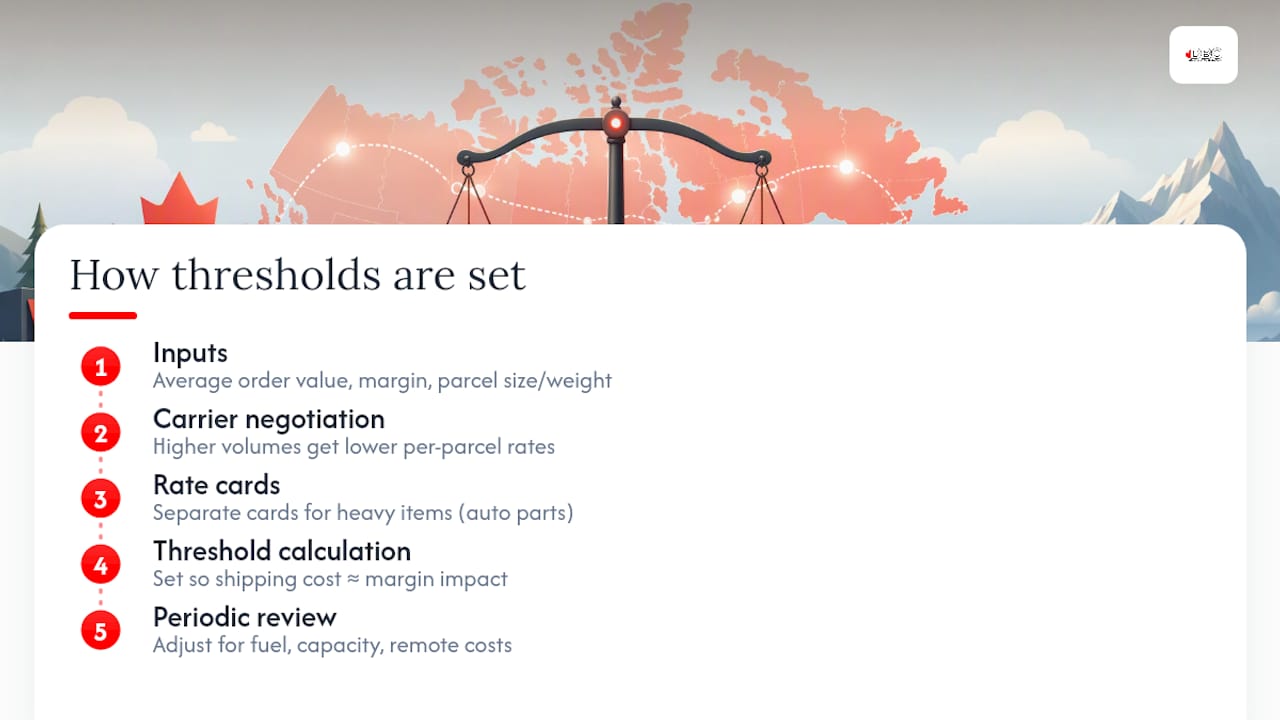
Retailers also revisit these agreements periodically as fuel surcharges, carrier capacity, and remote-delivery costs shift. A threshold that made sense a year ago can move up or down as the underlying carrier contract changes, which is one more reason the advertised number is worth reconfirming rather than assumed to be permanent.
What actually matters when you're checking a free shipping rule
The advice repeated across most shopping guides treats free shipping as a single number to hit. That's not wrong, but it skips the part that actually costs shoppers money: what counts toward that number in the first place.
Whether a threshold applies before or after a discount code, and whether your postal code quietly falls into a remote-delivery surcharge, matters more than the headline dollar figure most articles lead with. A $35 threshold that excludes your rural address isn't really a $35 threshold. It's a shipping charge with a coupon-shaped disguise.
The category that gets shortchanged most in this conversation is heavy goods, including auto parts. Shoppers assume a general $35 or $50 rule applies everywhere, then get blindsided by a flat shipping fee on a brake kit that weighs more than a typical parcel. That's exactly why DBC Brakes lists its Canadian free-shipping threshold plainly at $100, rather than folding it into vague marketing language.
If there's one thing to prioritize, it's this: read the exact eligibility wording before you buy, not after the shipping charge appears.
— Sam
DBC Brakes' free shipping threshold for Canadian orders
Auto parts shipping is where most free-shipping promises fall apart, since a rotor or brake kit weighs enough to break the assumptions built into a general retailer's shipping rule. One retailer avoids that guesswork by publishing one plain number for Canadian customers.
Orders over $100 ship free within Canada, with no separate weight surcharge tacked on for cross-drilled rotors or full brake kits. The listed threshold covers standard domestic delivery on eligible orders; expedited shipping and international orders are priced separately and listed on the same shipping page, so there's no hidden fee buried in fine print. Pricing on every product line, including the Performance XDB, Premium Black Kote, and Performance SS kits, is inclusive from the product page onward.
If you're comparing brake parts and trying to figure out whether your cart clears a shipping minimum, browse the brake kits collection and check your total against that $100 line before checkout. It's a simple number, stated once, with no membership tier required to unlock it.
Where to verify these free shipping rules yourself
Retailer policies change, so it's worth checking the primary source rather than relying on secondhand summaries, including this one.
- Amazon Canada's shipping help page confirms the $35 eligible-order threshold and lists current seller and location exclusions.
- Staples Canada's shipping page shows the $35 minimum alongside the actual charge applied below it.
- Gap Canada's shipping and handling page demonstrates how membership status changes the threshold.
- Strictly Auto Parts' shipping page outlines how a Canadian auto parts retailer handles heavy-item delivery and regional timing.
- DBC Brakes' shipping information page states the $100 Canadian free-shipping threshold and expedited/international rates.
Pro Tip: Screenshot the cart message confirming free shipping before you complete checkout. If the charge appears anyway, you'll have proof of the original offer.
Sources
- Order with Free Shipping by Amazon - Amazon Customer Service
- Free shipping (Staples Canada content)
- Shipping and Handling Information
- Shipping Information - Canada | Strictly Auto Parts
FAQ
What is the threshold for free shipping in Canada?
Most Canadian retailers set free-shipping minimums between $25 and $100, with $35 being common at large marketplaces like Amazon Canada and higher thresholds typical for specialty or heavy-item sellers. DBC Brakes sets its own Canadian threshold at $100 for free shipping on eligible orders.
Will Canada Post offer free shipping on Tuesdays in 2026?
There's no confirmed Canada Post promotion offering blanket free shipping on Tuesdays. Free-shipping thresholds are set by individual retailers using Canada Post or other carriers, not by Canada Post itself, so any "free shipping Tuesday" claim would come from a specific retailer's own promotion, not a carrier-wide policy.
Does Amazon still have free shipping over $25?
No, Amazon Canada's current published threshold is $35, not $25, for eligible orders shipped to existing customers. Some sellers and remote locations remain excluded from that threshold regardless of order size.
Does Walmart still have free shipping over $35?
Retailer thresholds shift over time, so the exact current figure should be confirmed directly on the retailer's own shipping page rather than assumed. Checking the retailer's help page or running your cart through checkout, as outlined earlier in this guide, remains the most reliable way to confirm the active threshold.
What counts toward a free shipping minimum?
Most retailers calculate the threshold using your subtotal after discounts but before tax, though gift cards, warranties, and oversized items are frequently excluded. Staples Canada's policy confirms this ordering, but the exact exclusions vary by retailer, so it's worth checking each site's specific wording.