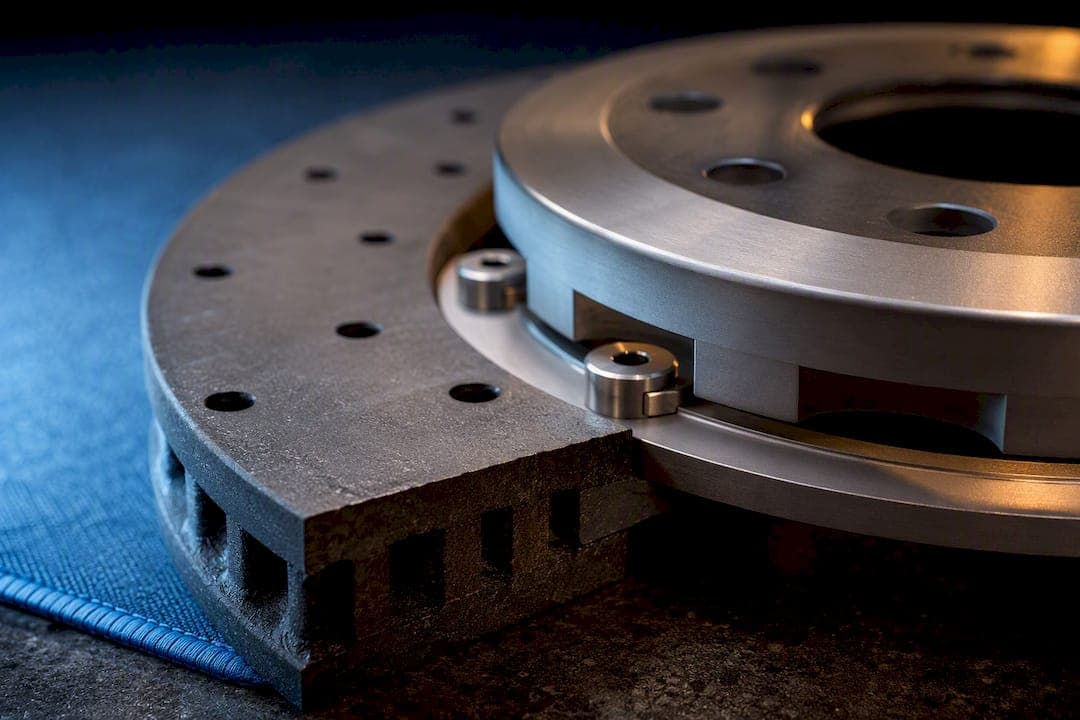
Two-piece rotors earn their price on track cars, heavy-duty trucks, and vehicles doing repeated hard stops, where reduced unsprung mass and better heat handling actually show up in stopping distance and pedal feel. For a daily commuter, a quality one-piece vented rotor does the job for less money and less upkeep. The trade-off is straightforward: more upfront cost and slightly more service knowledge required, in exchange for lighter wheels and a rotor you can partially rebuild instead of replacing outright.
TL;DR:
- Two-piece rotors provide significant heat dissipation and stress relief benefits mainly for frequent or intense braking, such as on track or heavy-duty vehicles.
- The main advantages include reduced unsprung weight from aluminum hats and the ability to replace worn friction rings without changing the entire rotor.
- Floating designs offer better thermal expansion management but require more maintenance checks, while fixed rotors are simpler and better suited for daily driving.
- Costs are higher upfront for two-piece rotors, but long-term savings may be achieved through ring replacements and better durability during repeated heat cycling.
- For normal city driving, a quality one-piece vented rotor typically suffices, with two-piece options primarily justified for racing, autocross, or heavy-duty use.
Table of Contents
- What makes a two-piece rotor different from a one-piece rotor
- Performance gains, weight savings, and what they cost you
- Floating versus fixed two-piece rotors
- Rotor materials, vane design, and surface finishes
- Servicing a two-piece rotor: resurfacing, ring swaps, and what to inspect
- Matching two-piece rotors to how you actually drive
- Fitment, installation, and what to budget
- What a dependable brake supplier actually looks like
- When I'd actually recommend a two-piece rotor
- Get a tested two-piece rotor kit without guessing on fitment
- Sources
What makes a two-piece rotor different from a one-piece rotor
A one-piece rotor is a single casting. The hat, which bolts to the hub, and the friction ring, which the pads clamp against, come out of the same mould and stay that way for the rotor's life. A two-piece rotor separates those functions into two parts: an aluminum or steel hat (sometimes called a carrier) bolted or floated onto a cast iron friction ring. The two pieces are joined with bolts, bobbins, or rivets rather than being cast as one unit.
Manufacturers split the design for a few concrete reasons. The friction ring and hat expand at different rates when they heat up under hard braking, and letting them move somewhat independently reduces the stress that builds when one piece tries to expand faster than the other. Building the hat from aluminum instead of cast iron cuts rotating mass, which matters more than static weight because it's mass the engine and suspension have to accelerate and decelerate every time you brake or corner. And because the ring is a separate, replaceable part, a shop can swap a worn or cracked friction surface without touching the hub-mounted carrier.
Spotting a two-piece rotor is easy once you know what to look for:
- Small bolts or rivets around the hat-to-ring interface, usually visible from the back of the wheel with the tire off
- A visible gap or step where the ring meets the hat, sometimes with a slightly different finish or colour between the two materials
- A parts diagram or service manual listing "friction ring" and "hat" or "carrier" as separate line items, rather than one rotor part number
- Aftermarket kits marketed explicitly as "two-piece" or "floating" rotors, which almost always highlight the separate hat
If your vehicle's parts catalogue lists one rotor SKU per corner with no separate ring, you're running a conventional one-piece design.
Performance gains, weight savings, and what they cost you
The core performance case for two-piece rotors rests on three things: lower rotating mass, better heat cycling, and reduced warping risk. Aluminum hats cut unsprung and rotating weight compared to an all-cast-iron rotor of the same diameter, and less rotating mass at each corner means quicker wheel response and marginally less strain on suspension components over repeated hard stops.
Statistic: Enthusiast track-day discussions comparing two-piece and one-piece rotor swaps report meaningful per-corner weight reductions, though the actual figure swings widely depending on rotor diameter, hat material, and the one-piece rotor being replaced. Treat any specific number you see online as a data point from one build, not a guaranteed result for yours.
Heat management is where two-piece rotors have a real, physics-backed advantage. Because the friction ring isn't rigidly fused to the hat, it can expand and contract with heat without transmitting as much stress into the hub assembly. That reduces one of the main causes of rotor warping: uneven cooling that leaves residual stress in a one-piece casting after repeated heavy braking.
The trade-offs are just as real:
- Two-piece rotors cost more upfront than equivalent one-piece designs, often by a meaningful margin per axle
- The ring-to-hat interface (bolts, bobbins, or rivets) is another wear point that needs periodic inspection, particularly after track sessions
- Replacement rings and brackets need to be sourced correctly, and availability varies by vehicle and manufacturer
- On a daily-driven commuter doing normal city and highway stops, the benefits are marginal. You're unlikely to generate enough heat cycling for the design to matter
Where two-piece rotors clearly pay off is repeated hard braking. The same principle that makes vented rotors reach a lower equilibrium temperature during repeated stops applies here: a rotor that sheds heat and stress more effectively fades less on lap six than lap one.
Floating versus fixed two-piece rotors
Two-piece rotors split further into two mechanical approaches, and the difference matters more than most buyers expect.
Floating rotors let the friction ring move slightly relative to the hat, usually through bobbins that sit in slotted holes rather than tight boltholes. That small amount of lateral and radial play lets the ring self-centre as it heats up and expands, which keeps the rotor running truer under extreme thermal load. It's the design you'll see on serious track and racing setups, where thermal cycling is aggressive and consistent.
Fixed rotors bolt the ring rigidly to the hat with no intended movement. They're simpler, have fewer wear points, and are quieter because there's no bobbin play to generate rattle or knock. For street use and moderate performance driving, fixed two-piece rotors deliver most of the serviceability benefit (a replaceable ring) without the added complexity of a floating interface.
Pro Tip: If you're daily-driving a car with occasional weekend track days, a fixed two-piece rotor is usually the better call. Floating designs need periodic bobbin and tolerance checks that most street drivers won't stay on top of, and a neglected floating rotor can develop an annoying rattle at low speed.
A quick way to match the design to your driving:
- Street and commuting: fixed two-piece or a quality one-piece rotor covers it
- Towing or heavy-duty use: fixed two-piece for durability without extra maintenance points
- Spirited weekend driving: fixed two-piece is usually sufficient
- Dedicated track use: floating two-piece rewards the extra inspection with better thermal consistency lap after lap
Rotor materials, vane design, and surface finishes
Most rotors, one-piece or two-piece, come in either vented or solid construction. Vented rotors have an internal channel between two friction surfaces that pulls air through as the rotor spins, shedding heat far faster than a solid disc. That's why vented rotors dominate front axles on nearly every modern vehicle. Solid rotors, common on rear axles, work fine because rear brakes handle less of the vehicle's braking load and generate less heat.
Rotor vane design inside a vented disc affects airflow efficiency: curved or directional vanes pump air more aggressively than straight vanes, but they also require the rotor to be installed on the correct side of the vehicle.
Beyond vented versus solid, you'll see three common face treatments:
- Drilled rotors have holes through the friction surface to vent brake gases and clear surface debris, though drilling increases crack risk under sustained extreme heat
- Slotted rotors cut shallow grooves across the face instead of holes, clearing pad material and gas without removing as much rotor mass
- Drilled and slotted rotors combine both, common on performance street builds that want the benefits of each without going full race-spec
Two-piece rotors typically pair a cast iron friction ring, chosen for its heat tolerance and wear resistance, with an aluminum hat that isolates heat from the hub and bearing. Coatings on the ring's non-friction surfaces help resist corrosion, though any coating on the actual braking surface needs to wear off during bed-in before full pad contact and stopping power develop.
Servicing a two-piece rotor: resurfacing, ring swaps, and what to inspect
The friction ring on a two-piece rotor can usually be resurfaced the same way a one-piece rotor is, provided it's still within minimum thickness specifications after machining. Where two-piece rotors pull ahead is what happens when the ring wears past that point.
- Check ring thickness against the manufacturer's minimum spec before deciding between resurfacing and replacement.
- If the ring is too thin or cracked but the hat is undamaged, order a replacement friction ring rather than a full assembly. This is often the meaningful cost saving that justifies two-piece rotors long-term.
- Inspect the hat for corrosion at the mounting face, a common failure point on vehicles that see winter road salt.
- Check fastener torque and inspect for seizure. Bolts and bobbins that have never been removed can corrode in place over several years.
- Measure rotor runout with a dial indicator after reassembly. Excess runout after a ring swap usually points to debris or corrosion between the ring and hat mating surfaces.
Pro Tip: Always use the torque spec and threadlocker grade the kit manufacturer specifies for ring-to-hat fasteners. Overtightening bobbin-style hardware on a floating rotor defeats the whole point of the design by binding the ring in place.
Sourcing matters here. Not every replacement ring fits every hat, even on the same vehicle platform, so confirm bolt circle and ring diameter before ordering. Suppliers focused on replacement rings and brackets for multi-piece assemblies are worth checking before assuming you need a full rotor.
Matching two-piece rotors to how you actually drive
Run through this checklist honestly before spending the extra money:
- Typical use: Mostly commuting and errands? A one-piece vented rotor is the practical choice.
- Track frequency: Regular track days or autocross? Two-piece, likely floating, starts paying for itself in consistency.
- Towing or heavy loads: Trucks and tow vehicles benefit from the durability of a fixed two-piece design without needing floating complexity.
- Noise sensitivity: If you want a silent brake system, skip floating designs and stick with fixed two-piece or one-piece.
- Budget for parts and labour: Two-piece rotors cost more initially, but ring-only replacement can offset that over the vehicle's life, provided rings stay available.
A weekend track car with occasional street duty is the clearest case for a two-piece setup. A daily commuter rarely needs one. A tow vehicle sits in between: a fixed two-piece rotor or a well-built one-piece vented, drilled, or slotted rotor covers most needs without adding maintenance complexity. If two-piece doesn't fit your budget or use case, upgrading pad compound and improving brake cooling ducting often delivers a noticeable improvement for far less money.
Fitment, installation, and what to budget
Before ordering any two-piece rotor, confirm three things: bolt pattern and hub centring match your hub exactly, caliper clearance accommodates the rotor's outer diameter and hat height, and the hat depth matches your wheel's offset so the caliper and wheel spokes don't interfere.
Installation follows the same basic steps as a one-piece rotor swap: remove the wheel and caliper, remove the old rotor, clean the hub face, and torque the new rotor and caliper to spec. No specialty tools are required beyond a torque wrench and, ideally, a dial indicator to check runout after installation.
Cost expectations vary by vehicle and market, but a few patterns hold generally:
- Two-piece rotor kits cost more per axle than equivalent one-piece rotors, reflecting the extra machining and hardware
- Labour for a straightforward rotor swap is comparable between one-piece and two-piece designs, since the installation steps are nearly identical
- Replacement rings alone typically cost less than a full new assembly, which is where the long-term savings show up
- Ask any supplier about warranty terms, the specific material spec of the friction ring, and whether replacement rings are stocked separately from the full kit before you buy
What a dependable brake supplier actually looks like
A reputable supplier should back up performance claims with material specifics, not just marketing language. DBC Brakes builds its cross-drilled rotors around corrosion resistance and consistent construction, addressing two of the most common failure points covered above: hat corrosion and ring quality.
Inclusive pricing with no hidden fees matters when you're comparing a two-piece kit against a one-piece upgrade, since labour and hardware costs can otherwise sneak up on you. DBC Brakes pairs that with free shipping on orders over $100 within Canada and support from staff who can answer fitment and spec questions directly, rather than routing you through an automated system. When you're checking a supplier against the decision checklist above, warranty terms, material specs, and spare-parts availability are exactly what to ask about before you order.
When I'd actually recommend a two-piece rotor
If someone tells me they're doing regular track days or autocross, two-piece rotors move up my list fast. The heat cycling argument is real, not marketing fluff, and I've seen enough warped one-piece rotors on cars doing repeated hard stops to take it seriously.
For a daily driver, I'd rather see the budget go toward better pads and brake ducting first. Two-piece rotors solve a problem most commuters don't have. Save them for the car that actually generates the heat to justify them.
— Sam
Get a tested two-piece rotor kit without guessing on fitment
Sourcing individual rings, hats, and hardware separately means juggling multiple part numbers and hoping they're actually compatible. DBC Brakes sells complete brake kits engineered as matched sets, so you're not stuck cross-referencing bolt patterns and hat depth on your own.
Some kits ship with cross-drilled rotors built for corrosion resistance and consistent bedding-in, backed by inclusive pricing that shows the full cost upfront, with no surprise fees at checkout. Before ordering, confirm your vehicle's bolt pattern and caliper clearance against the product listing, and ask the supplier's support team about spare-ring availability if planning for long-term serviceability. Browse the premium brake kit lineup and check fitment for your vehicle to get started.
Sources
- What is a vented rotor? · Help Center
- Brake Rotors: Solid, Vented, Drilled or Slotted - which ones are right for me? | AutoGuru
- Brake Rotor Types: A Complete Guide to Your Choices - Car Truck Advisor
- What's Better: Solid or Ventilated Rotor Discs in Your Brake System? | On All Cylinders